If your shoulders aren’t growing three-dimensionally, you might miss out on achieving a V-shaped upper body. You lose the chance to enhance your overall lean, attractive, and athletic look. Additionally, a lack of shoulder development hinders the creation of distinct shoulder muscles. These muscles should stand out from the rest of your muscle mass.
Unfortunately, many people make the same common mistakes that prevent them from adding any significant mass to their shoulders. So, here I am about to talk about the most common mistakes that prevent you from bulking up your shoulders.
You don’t train through a full range of motion
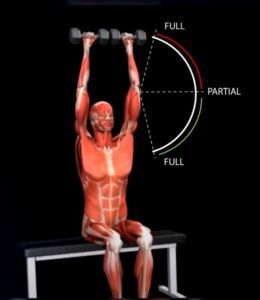
Next time you do overhead presses, take a look at how most people perform the exercise. If you can go all the way down on the press, you are doing it right. Most people press the weight back up to where their upper arms are parallel to the floor. Then, they lower the weight down to where their hands are at least at ear level. You can lower the weight even further until the dumbbells sit at the exact same height as your shoulders.
The motion mostly stimulates the delts during the lower middle phase. This helps because the bottom part of the overhead press primarily targets the deltoids. Conversely, the triceps largely control the upper part of the movement. We can divide the motion of an overhead press into a lower and upper portion. We clearly see that the triceps heavily lock out the weight during the upper phase.
Full-range squats stimulate muscle growth more than partial squats
This exercise fires up your shoulders heavily in the lower and middle portions. This likely happens due to the much greater range of motion involved.
Research indicates that training through a wider range of motion improves overall muscle growth. Full-range squats are more effective than partial squats in stimulating leg muscles. You can safely perform these at home using a wall-mounted squat rack. Similarly, full curls benefit biceps development much more than partial curls.
Overemphasize the front delts, while neglecting the side and rear delts
Another common mistake involves focusing too much on the front delts. You might not focus enough on the side and the rear delts. Targeting these often-neglected areas with specialized equipment like a rear deltoid machine makes a massive difference. People usually do this unintentionally, and this issue affects even advanced bodybuilders. Forming a disproportionate amount of volume for your front delts is common for two reasons.
First, the overhead press remains a staple shoulder exercise in everyone’s routine. Unfortunately, it focuses primarily on the front delts. Meanwhile, the sides and rear delts experience much less activation. The second major issue involves your horizontal pressing exercises. You already train your front delts heavily during movements like the dumbbell and barbell bench press.
So, when you are utilizing chest workout machines to maximize growth or training your back, you also work on your deltoids to some degree. This is especially true when you perform exercises like pull-ups, rows, and bent-over rows.
But that is not the case with side delts. These side muscles actively help give your shoulders that wide look. You should avoid upright rows, however, because they can easily cause shoulder impingement. Compound exercises like bench presses, pull-ups, and rows do not activate your side delts very much.
Aside from the aesthetic benefits, focusing on the side and rear delts improves posture and shoulder health. A recent study published in the Journal of Clinical Biomechanics confirms this. It finds that training deltoids on either side of the body protects your shoulder joint. It also reduces injury risk and increases your overall muscular tone.
Leaving your shoulder exercises until the very end of your workout
However, many people who want to grow their shoulders do not prioritize them. First, determine whether your split training routine combines chest, shoulders, and triceps. You might start a typical push-heavy workout with bench presses and dumbbell presses. These heavy lifts will exhaust your shoulders early. You will have no energy left for explosive movements like shoulder presses.

You might be primarily focused on growing your chest. If so, your workout routine works perfectly by starting with chest exercises. However, you might want to achieve better shoulder development instead. In this case, you should actively focus on working your shoulders first during your workout.
Combining different arm workouts on separate days lets you favor different muscle groups more effectively. You can work out the shoulders, biceps, and triceps—perhaps by mastering the machine tricep press—on completely separate days. This approach ensures that each specific muscle group gets the attention it deserves.
Raises and reverse flies using high-quality weights (like those covered in our Nuobell dumbbell review) prove extremely beneficial for balancing out the shape of your shoulders. You might begin the workout with overhead presses to target your front delts. Starting your routine with shoulder exercises helps you lift significantly more weight. This fresh energy directly benefits your overall muscle growth.
Allowing your traps to take over your delts
Another mistake involves allowing your traps to take over for your delts. This does not happen to everyone. Some people feel side delt exercises entirely in their traps rather than their shoulders.
These exercises activate the traps heavily, causing them to grow while the shoulders lag. With this increased activation, the traps grow out of control while the shoulders fall behind. This creates a difficult situation. You cannot stimulate your delts without also engaging your traps in the movement. The good news is that you can actively reduce trap recruitment.
First, you should static stretch your traps before you do your shoulder workout. Several studies prove that stretching a muscle for 60 seconds reduces subsequent muscle activation during exercise. Simply bending one arm and placing it behind your back will effectively stretch your traps.
Applying progressive overloading
Many weightlifters try to beat the weight they lifted the previous week or month. This is a great thing because increasing the stress placed on your muscles stimulates growth. However, you must not overdo it, and you must allow your body time to recover.
I find very few people actively trying to increase their weight on compound shoulder exercises. They especially neglect adding weight to isolation exercises like lateral raises. That is a big mistake when doing shoulder exercises or any other routine. You want to focus heavily on progressive overload. This means that you must gradually increase the total workload placed on a muscle. It does not need to be a huge increase.
Small weight-lifting increments add up to large gains over time. You should focus on increasing your lifts by just two and a half pounds each month. You might lift a certain weight for 10 reps without hitting muscle failure. You must increase that weight load until you fail at six or seven reps. Then, work on getting your rep count back up to 9 or 10 reps. Once you reach that goal, up the weight load again and repeat the entire process.
Tracking your workouts proves highly beneficial for this exact reason. You need to know how much weight you used during your last couple of workouts. You also need to record how many reps you completed with that specific weight. This way, you will always have a measurable number to beat over time.
You are not doing enough overall training volume
Another issue you might face involves training volume. Aside from just not upping your weight load, you might not be doing enough overall training volume.
How many sets and repetitions should you do?

If you only do a couple of sets here and there, you need to increase your training volume. More sets and repetitions will result in more muscle growth. A recent meta-analysis found a dose-response relationship between training volume and muscle growth in trained lifters. The more sets the participants did, the more muscle they gained. Another eight-week study observed this exact result when participants completed three or five sets of each exercise. The results once again showed that higher training volumes led to more muscle growth.
So, if your shoulders are not growing, try doing more sets for that muscle every week. You might currently perform nine sets of shoulder exercises per week. Try working your muscles even harder by increasing to 12 or 15 sets per week. This volume increase might help you break through your plateau and see new gains in your shoulder strength and size.
Add mass to your shoulder
Sure, working out and eating healthy are both very important. However, your muscles will never grow if you do not consistently fuel your body with enough calories.
Consuming enough calories is crucial for maximizing muscle growth. Your shoulders might not be growing because you burn more calories than you consume. In this case, you must adjust your caloric intake to get your shoulders growing again. Keep in mind that you do not have to go wild stuffing yourself with food to maximize muscle growth.
A high-calorie surplus provides more energy than your body can use. Your body responds by storing this extra energy as fat. This can lead to weight gain, fatigue, and cravings for energy-dense foods. Instead, focus on eating a balanced diet containing healthy sources of protein, healthy fats, and fiber. You will get the energy you need and stay healthy overall.
A recent study proved this by comparing muscle growth and fat gain across individuals with different calorie surpluses. One group consumed a regular calorie surplus, while the other group consumed 600 calories more. After 12 weeks, both groups gained a statistically similar amount of muscle. However, the group consuming the additional 600 calories gained more than five times the amount of fat.
So, if you want to keep things simple, I recommend aiming for a targeted calorie surplus. Try consuming around five to eight percent above your daily maintenance level. That will be enough to maximize muscle growth while minimizing fat gain.
Not getting enough protein
Finally, last but not least, you may not be eating enough protein. So, not only is getting enough calories important, but consuming enough protein is also vital. The amino acids found in protein form the absolute foundation of our muscle mass. Muscle growth is all about building up more protein in a muscle compared to what breaks down daily. If you can accomplish that, your muscles will start to grow right away.
Your muscles will then start to develop definition. Just like with the calorie surplus, more is not necessarily more. A 2018 meta-analysis published in the British Journal of Sports Medicine found that you only need 0.3 grams of protein per pound of body weight daily. For a 180-pound person, this equals 131 grams of protein. Available scientific evidence suggests that consuming excess protein will not significantly impact your muscle-building progress.
Instead, I recommend saving those additional daily calories for healthy fats and carbs. These macronutrients can make your diet much more enjoyable. That about wraps it up.
Leave a Reply